

For an investor, nothing is more painful than being fundamentally right about a business and still earning mediocre returns. Let’s say you study a company’s financial statements, deep dive into its industry, estimate its intrinsic value, and finally conclude that your selected stock trades at a significant discount. Out of confidence, you believe it’s a great opportunity to buy at a ‘cheap’ price, and you add the stock to your portfolio.
Then? A year passes, and the business continues to generate profits, but still the share price has barely moved. Two years later, the valuation remains unchanged (if not worse). Meanwhile, other companies, which were trading at higher multiples, continue to outperform. Ultimately, what appeared to be an opportunity at first begins to feel like a grave mistake.
This painful experience has forced generations of investors to ask the same question: Why cheap stocks stay cheap for years? The most common answer is that markets are inefficient, but that’s not always true in investing.
When a stock is persistently ‘cheap’, the market is usually signalling something more important than temporary pessimism, which is why low valuation doesn’t tell the complete story; rather, it opens doors for an intelligent investor to identify if there are deeper concerns about the business, its future cash flows, or if those concerns are likely to disappear.
It’s very important to understand this mechanism the moment you say, “Oh my gosh, I found an undervalued stock!” This will shift your attention from “how cheap is this stock?” to an important question: “Why does the market believe this business deserves to be cheap?”
Sorry for taking a bit more of your time here (I needed to tell this).
So, in this article, we’ll (you and me) examine why cheap stocks often remain cheap for years, how to identify genuine bargains (not value traps), what causes a stock to re-rate, and a few questions exceptional investors ask before going all in.
3 Reasons Cheap Stocks Stay Cheap for Years
If a stock stays cheap for five or ten years, it doesn’t mean investors forgot it ever existed. Markets can certainly be irrational in the short run. Optimism, fear, and news headlines often drive stock prices away from intrinsic value for weeks or even months, but in the long term (over years), markets are very effective at recognising persistent business realities. So, when a company continues to trade at a depressed valuation year after year, the market is usually reflecting something (in the business) that has not changed.
Now, this doesn’t necessarily mean the market is always right, but it challenges you to begin your investment with the assumption that there is a “rational explanation” for this continued discount. In practice, most cheap stocks stay cheap for years due to one or more of the following reasons.
1. The Business is Getting Worse (Not Better!)
The first and the most painful reason is the business itself. Many investors spend too much time analysing today’s valuation and too little time analysing tomorrow’s business (ever thought how DCF methodology values a stock? There are FCFF and FCFE involved, which are based on “future business”).
A company may still be profitable with modestly growing revenues from time to time, but behind those numbers, the economics of the business may be quietly dying. Be it in terms of weakening competitive advantage, declining returns on invested capital, customers switching to better alternatives, or decreasing management’s ability to sustain the same level of earnings without spending more.
But all these changes don’t appear overnight. They happen gradually, making the business look statistically cheap long before the market fully recognises the long-term consequences. This is also the reason it’s very dangerous to rely on historical earnings only. A lower valuation based on last year’s profits doesn’t tell you much if those profits are unlikely to sustain.
Warren Buffett had to learn this the hard way (he admitted this in his 1989 letter) and wrote:
“Time is the friend of the wonderful business, the enemy of the mediocre.”
This quote is often interpreted as an argument for buying “great” businesses, but it equally emphasizes the mediocre ones, i.e., time exposes weak economics. Every year a mediocre business fails to improve, investors become less willing to pay a premium for its future earnings.
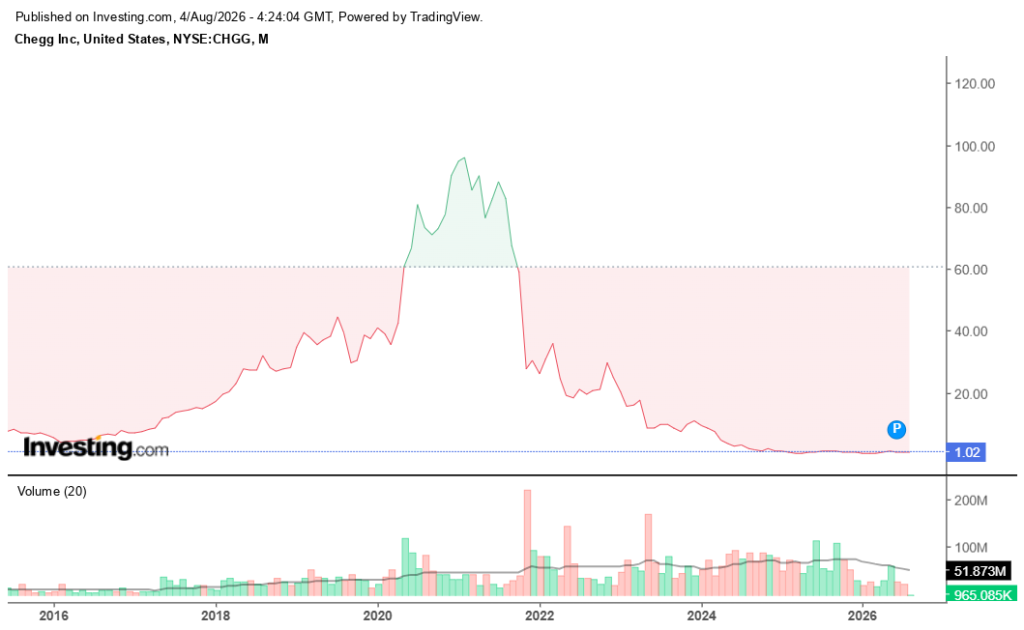
Let’s understand this (and the next 2 reasons) with a popular stock, Chegg (NYSE: CHGG), an American educational technology company providing homework help, online tutoring, textbooks, and other student services.
Picture credit: investing.com
Before Generative AI and ChatGPT, Chegg enjoyed the highest revenues (recording $776.3 million in the 2021 fiscal year). After the launch of ChatGPT and GPT-4, the revenues dropped dramatically, and the share price declined by nearly 50% on the first day of market opening on May 2, 2023, wiping out over $1 billion in market value. The management admitted the release of GPT-4 hurt their customer growth.
Source credit: Investing.com
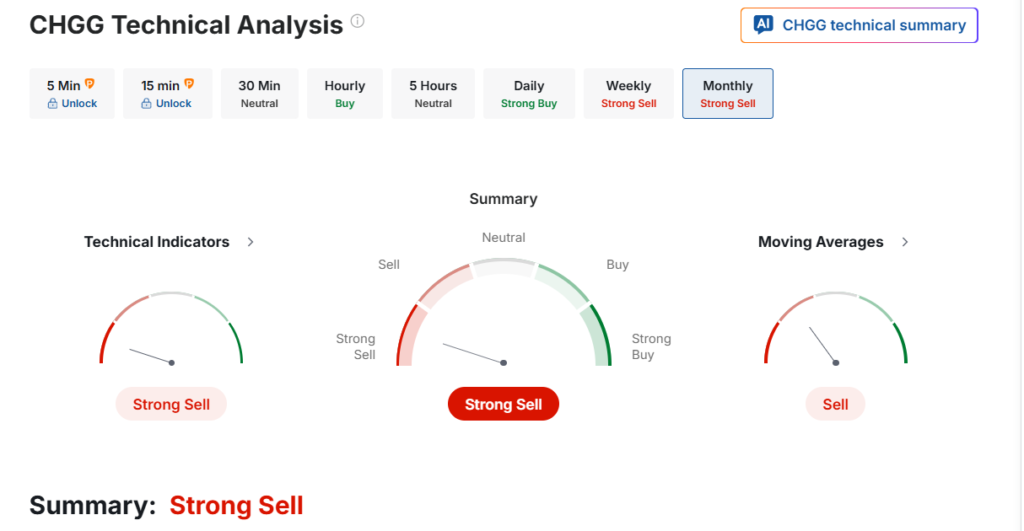
It was because the company couldn’t keep its competitive advantage (when GPT-4 came in), and due to this weakening competitive advantage, users switched to an easy and open-source alternative, thereby leaving Chegg with millions of dollars in impairment. However, Chegg tried to sustain its subscription model using AI-powered CheggMate (built using GPT-4), but students had no reason to pay for what they could get for free and even better.
2. Management Continues to Destroy Shareholder Value
Even an average business can create attractive shareholder returns if the management allocates capital diligently, but at the same time, a good business can remain cheap for years if its management repeatedly makes poor capital allocation decisions.
This is one of the most underrated reasons why valuations remain depressed, because investors often focus on products, revenue growth, or quarterly earnings while overlooking the single group responsible for deciding what happens to every dollar the business generates.
Ask questions such as: will excess cash be reinvested at attractive returns? Will acquisitions create value or simply increase size? Will debt strengthen the business or create a burden? Will management repurchase shares only when they are genuinely undervalued?
These are the decisions that shape future shareholder returns far more than most investors realise, and even markets understand this. And once management develops a reputation for destroying value through empire building, expensive acquisitions, poor reinvestment decisions, or consistently weak returns on capital, investors demand a permanently lower valuation multiple. (The discount is now a ‘credibility discount,’ which would take years to reverse back because trust compounds far more slowly than mistakes).
As William Thorndike concluded after studying exceptional CEOs in The Outsiders, long-term shareholder returns depend not only on operating performance but also on how intelligently management allocates capital. Businesses can recover from a weak year, but recovering from years of poor capital allocation is considerably harder (if not impossible).
3. No Credible Reason for the Market to Change Its Mind
The market needs to have some credible reasons and investors’ expectations change to re-rate the businesses, but if it finds nothing, the stock stays the same (just a little up and down). Suppose a company maintains a healthy balance sheet, generates stable earnings, and trades at a seemingly attractive valuation. Even then, one critical question remains: “Why should the market value it differently next year?
It means the market has to find credible reasons to change its mind, and investors never ask this. Rather, they assume the lower valuation itself is enough to attract buyers, but markets don’t re-rate businesses simply because they appear statistically cheap; they re-rate businesses when expectations change, and that ‘change’ usually requires evidence.
So, whatever the reason, something must convince investors that future cash flows are worth more than previously believed. With no such catalyst, the investment thesis becomes little more than waiting for other investors to notice what you already think is obvious (sometimes they never do). Chegg example can similarly be applied here, i.e., the market doesn’t see any reason to change its mind since AI is advancing at a rapid pace (leaving traditional QnA learning behind).
Howard Marks has repeatedly argued that successful investing depends less on identifying cheap assets and more on understanding whether market expectations are too pessimistic. A lower valuation without improving expectations often remains the same; a lower valuation.
Cheap Stock or Value Trap?
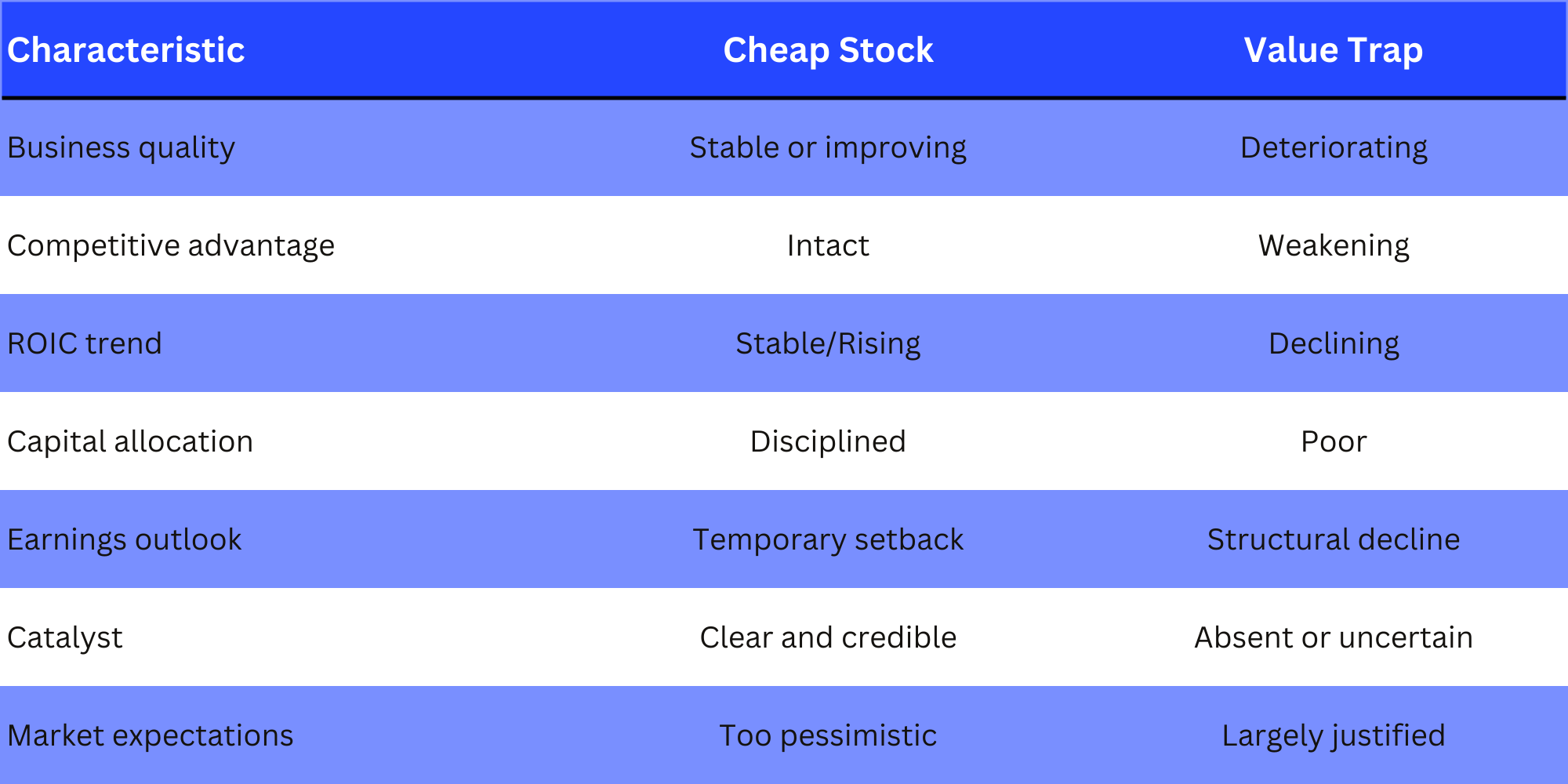
Before we identify whether the stock is really a cheap stock or just a value trap, let’s understand the difference between the two. A cheap stock is a simple company trading below what its future cash flows are worth (experts call it “undervalued bargain with stable or rising earnings”), while a value trap is a company or stock that appears undervalued on paper but suffers from permanent business decline (or only because investors overestimate the durability of its future cash flows).
Now, at first, a genuinely undervalued company and a value trap often look the same because both trade at depressed valuation multiples, both may have recently underperformed the markets, and maybe both are surrounded by cautious analyst reports, negative headlines, and pessimistic investor sentiment. Yet five years later, one investment (genuine bargain) may have doubled while the other (value trap) remains exactly where it started, worse.
Why?
Because the first possessed a durable competitive advantage, consistently earned high returns on invested capital, generated strong free cash flows, and was led by management with an excellent capital allocation record. Temporary concerns, perhaps short-term earnings disappointment or cyclical slowdown, depressed its valuation, but the long-term business economics remained largely intact.
Whereas the second traded at the same multiple but for entirely different reasons, which might include its industry being more competitive, management having a history of poor acquisitions, future earnings becoming less predictable, margins beginning to shrink, and so on. In short, both stocks were equally cheap earlier, but one was actually undervalued, and this is why relying on valuation multiples alone often leads investors into trouble.
CREDIT: The Wall street investor / JUnaid javed
Since markets may temporarily misprice businesses, but it doesn’t reward those businesses whose competitive position, capital allocation, or future earnings power continue to weaken, identifying a true bargain from a value trap requires investors to look beyond the income statement and understand business quality, management incentives, the industry’s long-term economics, and most importantly, whether the future is likely to be better than the past.
So, before buying any “cheap” stock, ask yourself four questions:
- Is the business becoming stronger or weaker?
- Is management creating or destroying shareholder value?
- What specific event could cause the market to reassess this business?
- If the stock remains this cheap for another five years, what assumption in my investment thesis would still make me comfortable owning it?
And if you cannot answer those questions with conviction, it means you’re not investing because the business is undervalued (which you’d think it is!) but because the valuation is low. Trust me, I wish these were the same thing.
What Actually Causes a Cheap Stock to Re-rate?
I think I already answered this question previously, but let me keep it here, too. A re-rating is simply almost the consequence of “changing expectations,” which means markets don’t wake up one morning and decide that a stock deserves a higher valuation; rather, it rewards the evidence that the future has become better than previously expected.
The evidence can take many forms, such as margins beginning to improve after years of decline, a new management team following disciplined capital allocation, the company’s competitive position starting to strengthen, cash flows becoming more predictable, or returns on invested capital beginning to rise again. (Remember I discussed this earlier, too?)
Just take a moment and notice what all these developments have in common. They simply improve the “future economics” of the business, telling you tomorrow’s improving business is rewarded by the market. This is the reason why catalysts matter.
Let me add something here: a catalyst is an event that changes investors’ expectations about future cash flows.
That’s why you, as an investor, need to find out potential catalysts a business has before calling it a genuine bargain. This would be an addition to your confidence in buying the stock.
Why Investors Keep Falling Into Cheap Stocks
Despite the fact that I have clearly mentioned certain characteristics of an undervalued stock (or what you call a ‘genuine bargain’) and how to differentiate it from a value trap, investors would still be tempted to keep buying value traps. There is no surprise in it because our brains are wired to love ‘bargains.’
Let’s take an example of our everyday life. Don’t we think we make a smart decision whenever we buy something at a discount? Of course, yes. If a high-quality laptop is suddenly available for 40% less, most people would consider it an opportunity because the product is the same, but its price is now lower (aka cheaper).
Unfortunately, investors unconsciously apply the same logic to stocks. They assume since the price has fallen, the opportunity has increased, but the problem is that stocks are not consumer products and their value isn’t fixed. It changes every day as the future economics of the underlying business change.
Simply put, a declining share price is therefore not always evidence that the investment has become more attractive; rather, it may simply reflect a deterioration in intrinsic value. Much to investors’ surprise, behavioural biases make this even harder to recognize. For instance;
1. Anchoring causes investors to compare today’s price with yesterday’s rather than with the company’s future earning power. A stock that has fallen from $100 to $50 immediately feels “cheap”, even if its intrinsic value has also fallen from $120 to $45. (read this again!)
2. Confirmation bias encourages investors to search for information that supports their original thesis while ignoring the evidence that the business is deteriorating. (it’s like a husband loving his wife, knowing she loves his friend, and later finds out he’s handing over 50% of his property to his ex-wife and friend!)
3. And perhaps the most dangerous bias of all is “mean reversion bias”; the belief that because a stock has underperformed for years, it is somehow due for a recovery (BS!)
Dear investor, markets don’t work that way, and stocks don’t rise because they have fallen; they rise because the underlying business improves faster than the market expects, which is why successful investors spend far less time predicting price reversals than understanding business fundamentals. They know that a large decline, years of underperformance, or a lower valuation is not a catalyst in itself.
Let me rephrase it for you (by Junaid Javed):
“A cheap stock deserves your attention, but what deserves your capital is a business with improving economics”
Evaluate Every Cheap Stock Before You Invest
By now, one thing should be clear: a low valuation is not an investment thesis in itself, rather an invitation to investigate more deeply. Before committing your capital to any seemingly undervalued company, step back from the financial ratios and ask the questions that actually determine long-term returns:
1. Is the business becoming stronger or weaker?
For a moment, ignore the share price (no matter how cheap!) and ask yourself: Are returns on invested capital improving or deteriorating? Is the company strengthening its competitive advantage, or merely defending it? Are margins expanding because of genuine operational performance or temporary cost cuts?
It’s essential to ask such questions because the business’s future economics matter far more than today’s valuation multiple.
2. Is management allocating capital intelligently?
Every dollar a company generates is eventually allocated somewhere, but where it is allocated matters the most. So, ask these questions: Will it earn attractive returns through reinvestment? Will management pursue disciplined acquisitions? Will excess cash be returned to shareholders when opportunities are limited?
It’s the second most essential question because a good business with poor capital allocation can be outperformed by a mediocre business with exceptional capital allocation.
3. Why is the market assigning this valuation?
Well, this may be the most important question of all. Instead of asking, “Why is this stock so cheap?” ask: “What future outcome is the market pricing in?”
Sometimes the market is overly pessimistic, but sometimes it’s also simply realistic, and your job here is to determine which is more likely.
4. What could change the market’s expectations?
Every successful investment asks for a thesis about the future. Be it a specific development that would make investors assign a higher valuation multiple, a successful turnaround, improving margins, better capital allocation, or a stronger competitive position.
If you cannot identify a credible reason why expectations should improve, it’s foolish to believe the valuation will unless it’s a miracle!
5. What am I missing?
I believe the most valuable habit shared by exceptional investors is their ‘intellectual humility’. Instead of trying to prove themselves right, they actively search for reasons they might be wrong. This is where reality comes in and helps them make better investment decisions.
Ask questions such as assumptions your thesis depends on, what evidence would invalidate your thesis, and why thousands of intelligent market participants are willing to sell you this stock at today’s price. Because these questions help you reduce avoidable mistakes even if they cannot eliminate uncertainty.
Eventually, investing is, for the most part, about identifying situations where the market’s expectations are more pessimistic than reality is likely to justify.
Conclusion
In short, we understood that cheap stocks don’t stay cheap because the investors are irrational but because the market believes something about the future that justifies the discount. Sometimes it’s not true, creating extraordinary opportunities for investors, but more often, the lower valuation challenges you to deep dive and confirm if it reflects genuine concerns about deteriorating business quality, poor capital allocation, or the absence of any credible reason for the future to improve.
This definitely requires you to think beyond valuation ratios and understand the business itself; its management, competitive positions, reinvestment opportunities, and long-term economics.
Now, the next time you come across a stock trading at half the market’s valuation, instead of asking a fantasy question like ” How much upside does this have?”, ask this: “What has to change for this business to deserve a higher valuation?” And the answer to this question will often tell you far more than the valuation multiple alone ever could.
Thank you for taking the time to read my article. I’m grateful to you. I’m working on another amazing article, and I’ll be sharing it once it’s finished. If you learned something from this article, I’d welcome your comments, opinions, and suggestions.
You can also reach out to me at editor@wsinvestor.com
Leave a Reply